lunes, 8 de agosto de 2016

Digital literacies in the classroom


  What are digital literacies, one may be wondering. They refer to “our ability to effectively make use of the technologies at our disposal”, technically and even socially. That means that a digitally literate is able to, for example, tweet something to someone appropriately – which means that the text is not going to be long (actually it can’t be!), maybe with some abbreviations, sticking to the point and with the people correctly tagged. In short, being a digitally literate implies knowing how to use technology, whom to address and in which way, as well as how to recognise real information from fake.

  Undeniably, we’re surrounded by technology, and education can’t look aside ignoring it. It’s part of both our students’ everyday life, and ours. Especially, in my opinion the focus of digital literacies in the school should be on information: how many times a student who was asked to gather information about a certain topic, appeared with anything but what he was supposed to look for? This happens because he didn't know where to search, or how could he rely on a certain web page.

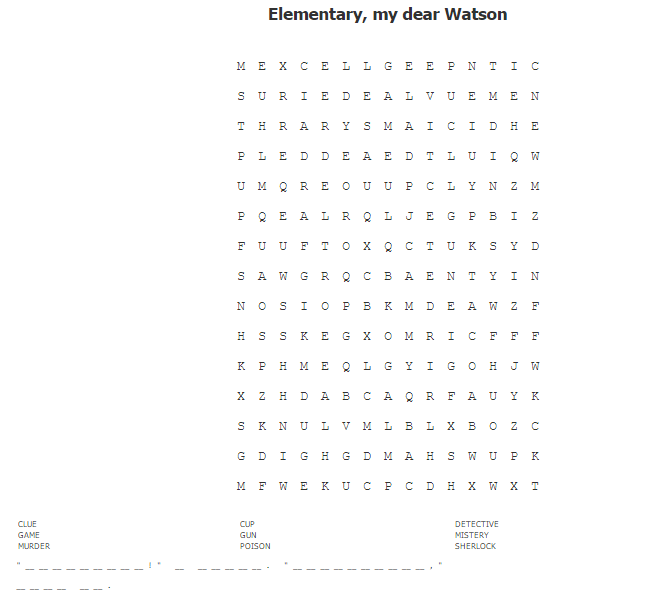
  In my case, following criteria from lesley.edu, I’ve analysed a couple of web pages with some partners, to determine whether they were reliable and also profitable. Here you can read the website reviews, where we designed a couple of activities for students, as the one in the figure below (ignore the fact that it's a bit too long, first time) using the puzzle maker from Discovery Education. In this activity, students will have to find out the secret message, that is the "real" Sherlock Holmes' saying, by first looking for the words written below, and then the message is revealed.

activity.png

Source: http://www.teachingenglish.org.uk/article/digital-literacies-what-are-they-why-should-we-care

jueves, 21 de julio de 2016

Grumbling again Gladys? Digital issues

  It was in 2001 that a document by Marc Prensky introduced the terms “Digital Natives” and “Digital Immigrants”, which he coined in an attempt to show the difference between people who were born with digital technologies and those who preceded them. The focus of his –if I can call them– concerns were on education, and fifteen years later most of them still seem to be existing. Since I don’t want to bore you with any kind of summary, here it can be read (it’s 6 pages long). Nevertheless, I’ve been pondering about two striking ideas that caught my attention.

  One of them was “Digital Immigrants think learning can’t (or shouldn’t) be fun. Why should they – they didn’t spend their formative years learning with Sesame Street.” (2001:3) This sounds (seems?) like the author hasn’t had any “funny” teacher, one who transformed the teaching of a dull, prosy text from a book into a catching lesson with tons of amazement and amusement. I’m sure that he didn’t actually mean what he said.


  The other, which I completely agreed with, was the conclusion: “So if Digital Immigrant educators really want to reach Digital Natives – i.e. all their students – they will have to change. It’s high time for them to stop their grousing, and as the Nike motto of the Digital Native generation says, “Just do it!” They will succeed in the long run – and their successes will come that much sooner if their administrators support them.” (2001:6) Apart from the grousing part which was hilarious because it was/is reasonably representative (and it immediately made me recall one text we've dealt with in phonetics and phonology in the first year), the last words are like floating in a sea of uncertainty. What if those administrators are also like the grumbling crew of Digital Immigrants? It seems that there’s no possible twist! Or is it some way, from the part of the students or a younger generation of leaders? What is your comment? 


Source: Prensky, M. (n.d.). "Digital Natives, Digital Immigrants." From On the Horizon (NCB University Press, Vol. 9 No. 5, October 2001)

lunes, 6 de junio de 2016

The role of the teacher as a material designer

  English teachers since the beginning of the twenty first century were widely known for using those famous CD players or “tortuguitas” (little turtles) as we call them in Argentina, showing in a way that they didn’t suffer from vertigo when rolling down in the increasingly fast whirlwind of advancements in technology. They demonstrated that they were up to the challenge and even grateful for having the chance of changing the old and heavy cassette recorder for something more practical. Nevertheless, in a way that was the only approach to technology teachers had, because computers were far more difficult to use than they are now, let alone smart phones, which were inexistent. 

  Today, we are in 2016 and undeniably surrounded by technology. Computers are much friendlier to the user and they also offer innumerable possibilities at the time of creating with them, also with the help of internet which is an inexhaustible source of information and materials.

  Having said so, and judging by the title, the reader may have started to think what this is about. The idea is to enter this full-of-possibilities new world of designing materials for our students, and to initiate ourselves in the role of the teacher as a material designer or even polish our existing designing skills, because some may already be walking in the land of creation.

  In that case, why do we start doing so? Several factors contribute to our getting down to work in this kind of commitment: the book we are working with is not that good in terms of the imagery provided by the authors, the activities are not contextualised enough, there is a lack of the type of reinforcement our students need, the stories are not catching, etc.

  Not only is the teacher a material designer and producer, but there are also many other roles which we fulfil when teaching such as assessor, facilitator, prompter, planner, role-model, and so on. Here my focus is on the former, since addressing all the following could be slightly chaotic. Nevertheless, there will be a bit of everyone present in each post, given that they are intrinsically related in the art of teaching.

  So, by this way I’d like to welcome you, the reader, and to make a request: feel free to share your ideas and contributions, and to take anything that is helpful for your lessons. I won’t charge for copyright ;) I believe that all teachers should help each other, especially with ideas and information about where we can improve a certain aspect of our teaching.